Dear Friend & Subscriber,
If you've been telling yourself "I should write a book" for years... and you have the expertise, the experience, and the ideas — but not two years of free time to sit down and actually write the thing...
Then this page will show you how you can use AI to write, edit, and launch your first book on Amazon in as little as 7 days.
All this without hiring a $20,000 ghostwriter, staring at a blank page, or publishing something that sounds like robot vomit.
Can You Answer YES To One Of The Questions Below?
- You want something that works for you even when you're not working — a book on Amazon that generates leads, builds trust, and opens doors while you're living your life...
- You've watched someone with half your experience publish a book and suddenly they're the one getting invited to speak, getting featured, getting the clients you should be getting...
- You want to be introduced as a published author — not because you need the ego boost, but because you know what a book does for your credibility. Clients who read your book show up pre-sold. You stop chasing and start choosing...
- You've been saying "I should write a book" for years — maybe even decades — but between work, family, and everything else, it never moves past the idea stage...
- You've tried sitting down to write, got 10 or 20 pages in, and then life happened. The draft is still sitting in a folder somewhere, collecting dust...
- You want a clear, step-by-step path from "I have ideas in my head" to "my book is live on Amazon" — without having to figure out formatting, cover design, KDP settings, and a hundred other things on your own...
If you answered yes to even one of the questions above, read this page carefully.
A Book Builds More Authority & Attracts More High Paying Subscribers Than 1,000+ Social Media Posts Combined
One book — even a short one — does more for your credibility than 10 years of social media posts combined.
When someone reads your book, they spend hours inside your head.
By the time they're done, they don't need to be "sold." They already trust you.
And that changes everything about how your business works.
Instead of chasing clients, they come to you.
Instead of explaining why you're qualified, they already know.
Instead of competing on price, you're competing on authority — and there's no contest.
Think about the people you respect most in your field. How many of them have a book?
Probably most of them. And it's not a coincidence.
A book is a trust shortcut. It says "I know what I'm talking about" louder than any LinkedIn post or certification ever could.
And here's what makes right now different from five years ago: you don't need to disappear for two years to write one.
You don't need a publishing deal. You don't need to be a "writer."
The tools exist today to take everything you already know — your experience, your frameworks, the stuff you explain to clients every single week — and turn it into a published book on Amazon.
The question isn't whether a book would help your business and your credibility. You already know it would.
The real question is: what's the alternative?
Shouting into a feed that buries your best post in 40 minutes?
Filming reels until your camera roll is full of takes you'll never post?
Replying to strangers in the comments at 11pm — "building relationships" with people who'll forget your name by breakfast?
That's the treadmill. You run hard, you sweat, and the second you step off, you stop existing. Miss a week and you're invisible again. The algorithm doesn't care what you did for it yesterday.
And here's the part that should sting: you've got 20, 30 years of hard-won expertise — and that game reduces you to fishing for likes from people half your age who've done a fraction of what you have.
A book doesn't work like that.
You write it once. And it keeps working — at 2pm, at 2am, on the days you show up and the days you don't.
One is a hamster wheel. The other is an asset that pays you back for years.
Now Imagine This...
Imagine having a book on Amazon with your name on it — something you can hand to a potential client, link in your email signature, or mention on a podcast.
Imagine the first time someone emails you and says "I read your book, and I want to work with you."
Imagine finally closing the loop on that voice that's been saying "I should write a book" for years.
That's not a fantasy.
That's what happens when you stop treating a book like a two-year project and start treating it like a one-week sprint.
A Book Builds You an Email List of Buyers — While You Sleep
Here's what nobody tells you about putting a book on Amazon.
Amazon isn't a bookstore. It's the biggest search engine for buyers on the planet.
Think about the difference. On X, people are there to kill time. On Amazon, people show up with their credit card already out — typing in the exact problem you solve.
So once your book is live, something quietly starts happening in the background.
Someone searches for help with your topic. Your book shows up. They buy it — and just like that, a complete stranger has paid you and invited you into their head for the next two hours.
By the time they hit the last page, they don't just like you. They trust you. They've spent more focused time with you than a year of social media followers ever would.
And on that last page, you invite them onto your email list.
Now think about who just joined.
Not a freebie-seeker who grabbed your PDF and forgot you existed. A proven buyer — someone who searched for your topic, paid for your book, read the whole thing, and raised their hand for more.
That's the highest-quality subscriber there is. And Amazon hands them to you for free.
Every day, while you're working, sleeping, or at dinner, Amazon keeps showing your book to new buyers — and your list keeps filling with people who are already pre-sold on you.
That's the part that changes your business. Not the royalties. The list of buyers your book builds for you on autopilot.
Most People Who Tried To Write A Book Failed Miserably
Maybe You've Tried Writing It Yourself.
You carved out a Saturday morning, opened a blank document, and started typing. The first few pages felt good — you were finally doing it.
But then you hit page 10 and realized you weren't sure where this was going.
You started re-reading what you'd written. Editing. Rearranging.
And before you knew it, three weekends had passed and you were still polishing your introduction.
The problem with "just writing" isn't that you're not a good writer.
It's that writing a book without a system is like driving cross-country without a map. You might eventually get there, but you'll burn through a lot of time and fuel going in circles.
And most people run out of gas around page 20.
Maybe You've Looked Into Hiring Someone To Write It For You.
And you quickly found out that a decent ghostwriter starts at $20,000 — with timelines stretching into months of interviews, revisions, and back-and-forth.
But the biggest risk isn't the money or the time.
It's that after all of it, the book might not even sound like you.
You read the draft and think "a professional wrote this," and not in a good way.
It's polished, sure. But it's missing your voice, your stories, the way you'd actually explain things to someone sitting across from you.
And for $20,000, that's a tough pill to swallow.
Maybe You've Tried Using ChatGPT.
ChatGPT was supposed to fix all of this, right?
Just paste in your topic, tell it to write a chapter, and you're done.
Except anyone who's actually tried this knows what happens.
You get something that reads like a Wikipedia article wrapped in a motivational speech. Definetly not something you can put name on it.
Every paragraph sounds like every other AI slop the "content bros" churn out on the internet.
So you either spend hours rewriting the AI output — which defeats the purpose — or you publish it as-is and hope nobody notices.
And they will notice.
Here's the truth: if you've ever struggled to get AI to write a decent blog post, how are you ever going to get it to write an entire book?
The problem isn't AI itself.
The problem is that most people use it like a vending machine: put in a topic, get out a chapter.
That's not how you get a book that sounds like you actually wrote it.
It Is NOT Your Fault!
If you've tried any of these and stalled out, that's completely normal. You weren't given the right approach.
Writing a book the traditional way takes forever. Ghostwriters are expensiv. And raw AI output sounds like a robot.
None of those paths were designed for someone who has the expertise but not unlimited time.
I Secretly Launched My Own Best-Selling Book On Amazon In Less Than A Week (And You Can Too!)
It wasn't my first attempt at writing a book.
I had this idea for years. I'd tried before. More than once.
And every time, the same thing happened.
First, there's the idea problem.
When you're looking at months of work ahead of you, you start second-guessing everything. "Am I even writing about the right topic?"
So you do some research on Amazon, look at what's out there, and somehow end up more confused than when you started.
And then — if you do pick something and start writing — you realize it's just going nowhere.
You write a few pages, reread them, edit them, rewrite them.
And then you start doubting your whole book topic. Maybe it's not the right book to write. Maybe should you do more research. Maybe, maybe, maybe...
But my situation made this even worse than it sounds.
In 2014, my L5-S1 nerve got so severely pinched that I was on the verge of finishing my life in a wheelchair.
I had surgery. It helped. But it didn't fix everything.
I still get electric shocks that run from my lower back down to my big toe: Sometimes it's a weird tingling. Sometimes it feels like someone's jabbing a live wire into my spine.Push past two hours at a desk and the shocks get worse, my leg goes numb, and the rest of my day is shot.
So the "sit at your desk for 8 hours and grind out a manuscript" approach?
That was never going to work for me.
Not in two years. Not in 6 months. Not in 4 weeks.
Most people would see that as a limitation.
For me, it became the constraint that shaped everything I build.
Because when you only have two hours to work, you can't afford complexity.
You can't waste time staring at a blank page. You can't spend three months second-guessing your topic.
You have to build something simple — something that actually works.
Over the past decade, that constraint pushed me to get obsessively good at using AI.
So when I finally sat down to write my book, I took everything I'd learned about AI, copywriting, and online writing — and I built a process specifically for this.
A real system where you sit down on Monday with an idea and by Sunday you're looking at your book on Amazon.
But here's the part that matters most for you...
I launched the same way you will — from zero
Look: I'm not new at "content creation." I have an email list of 12,065 subscribers:
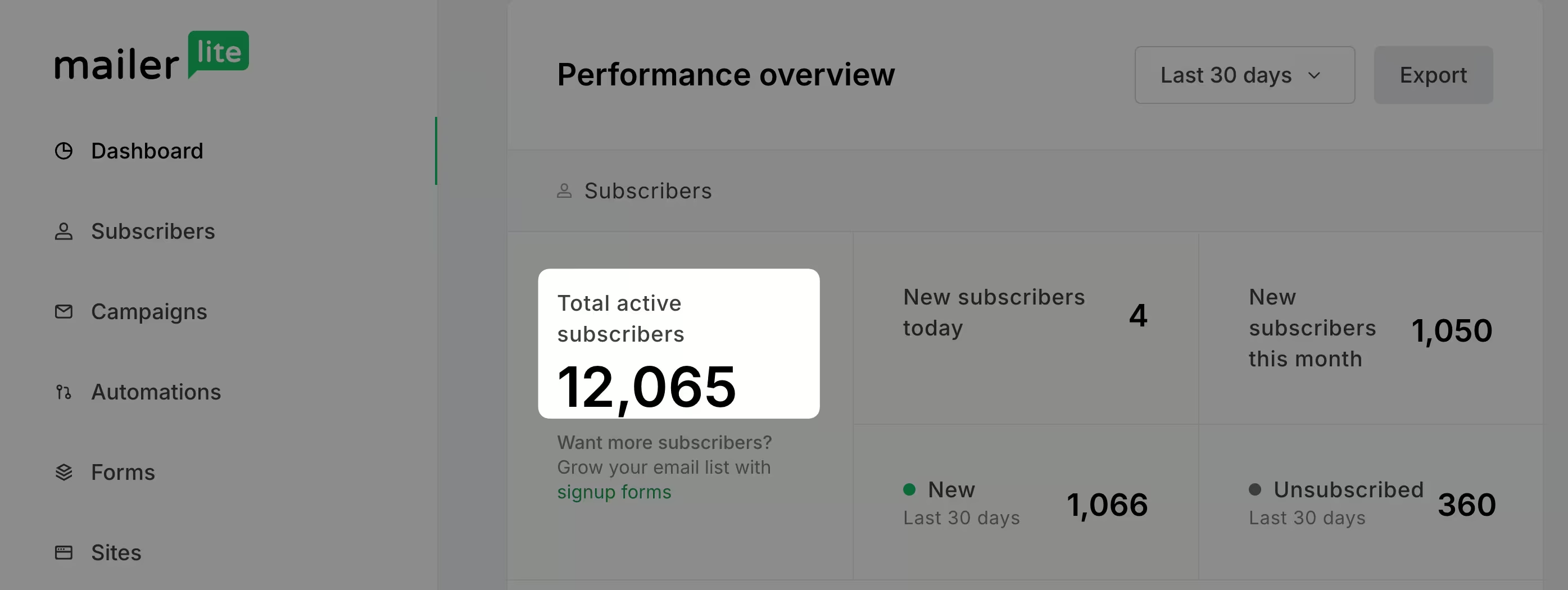
But I didn't tell a single one of them I was writing or launching this book.
Because I knew exactly what you'd be thinking if I did: "Sure, it worked for him — he already has an audience."
So I cut myself off from mine on purpose.
And with the system I'm about to share with you, here's what happened...
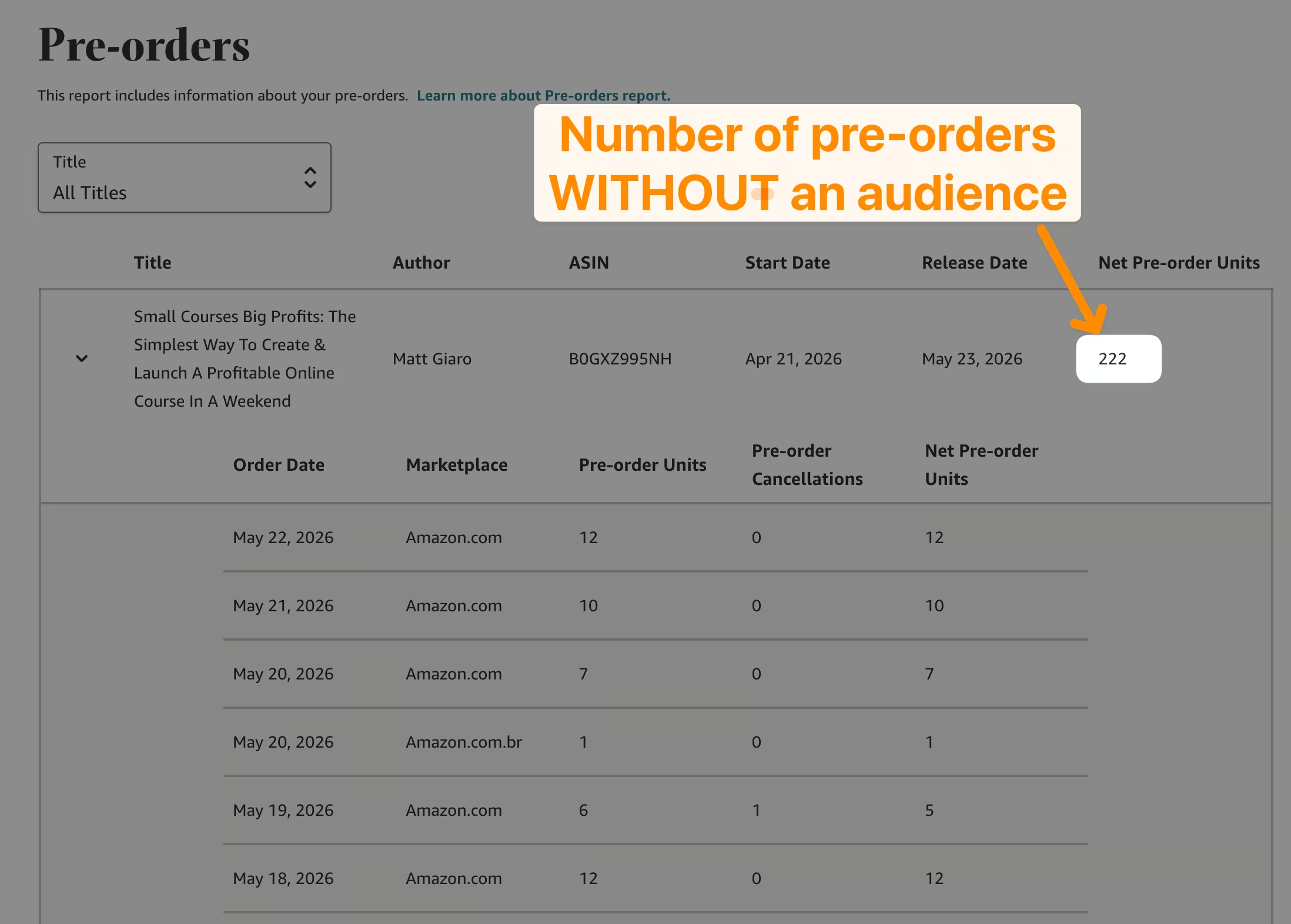
In the first 30 days, I sold 222 copies of my book:
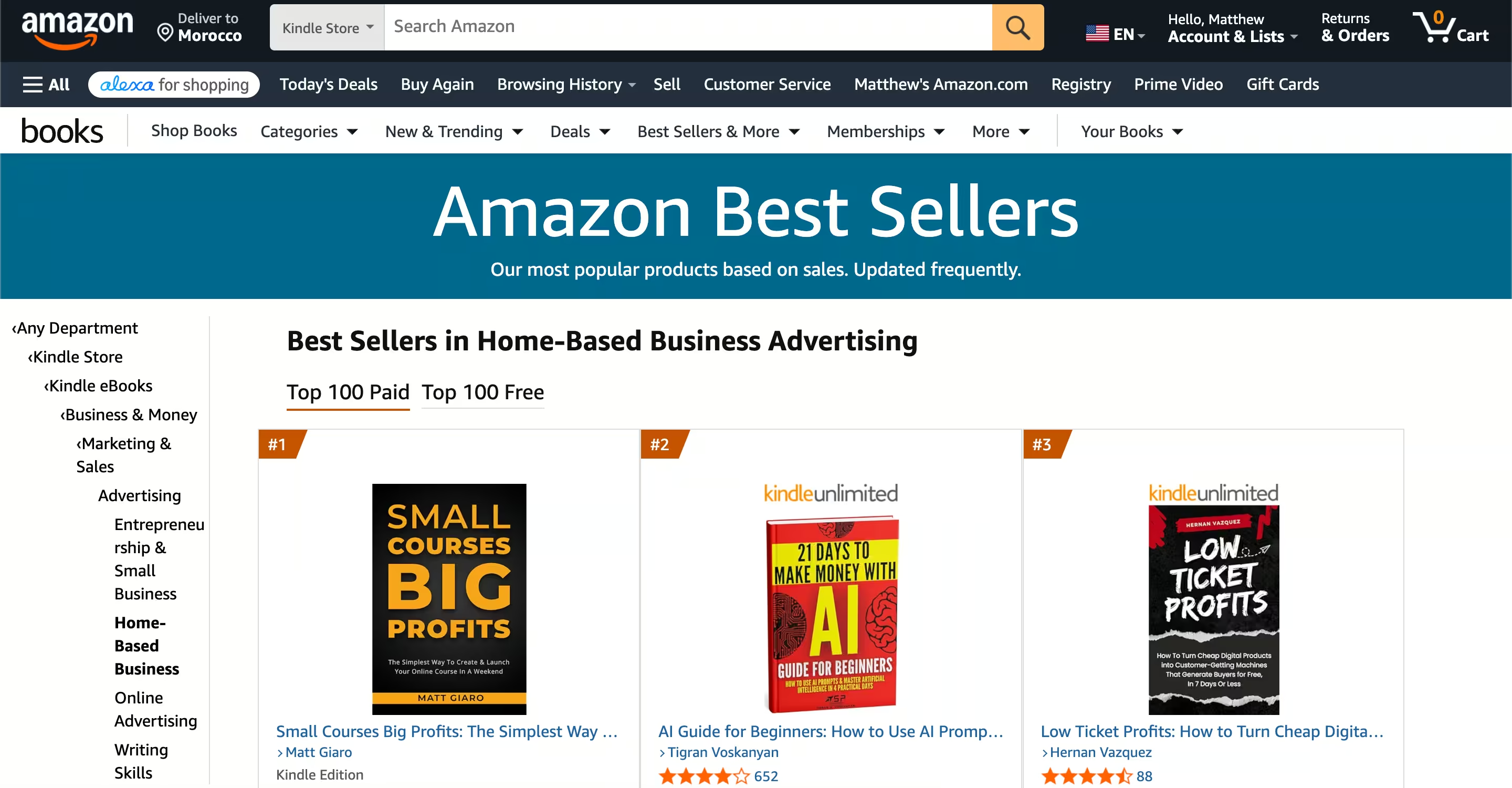
And the book became an Amazon best-seller:
I'm sharing this with you not to brag.
But because I don't want you to spend years in that thinking loop — second-guessing your topic, stalling on page 12, watching other people publish the book you should have written.
If I can do this with a broken back and two hours a day, you can do it too.
Let me be upfront with you
I can't guarantee you'll write your book in exactly 7 days.
Maybe it takes you 10. Maybe you only have weekends and it takes two of them.
But would it change things for you if you could go from "I have an idea" to "my book is live on Amazon" in a matter of weeks instead of years?
Because the method I'm about to share with you is simple.
It doesn't require writing talent (even though it helps). And it doesn't require you to quit your job and disappear into a cabin for 16 months.
It does require one thing: you need to actually know your subject.
If you've spent years doing the work — consulting, coaching, building, advising — then you already have the raw material.
You just need a way to get it out of your head and into a finished book, fast.
And that's exactly what this does.
Three things you should know about it:
No ghostwriter, no professional editor, no expensive software. The tools you need are free — or cost less than a nice dinner.
You don't need to be a writer or learn publishing. A step-by-step process handles the structure, writing, editing, cover, and launch.
You can realistically have a finished book on Amazon within a week or two — even working around a full-time job.
Now, you might be wondering how all of this is possible...
The Two Secrets to Writing a Book in 7 Days or Less
It comes down to two things: what you write, and how you write it.
Secret #1: Write a Short Read (not a 300-page monster nobody finishes)
Instead of writing a 300-page monster, you're simply going to write a short book — one you can write in a few days, and your reader can finish in about two hours.
That one choice makes everything easier: easier for you to write, easier to edit, and easy for your reader to read from the first page to the last.
Somewhere along the way, we all picked up the idea that a "real" book has to be 300 pages. So before you type a single word, you're staring up at a mountain. No wonder it never gets climbed.
But think about the last book that actually changed how you do something. Did it change you because it was thick? Or because it solved one problem, clearly?
A short, focused book beats a fat one. It gets read instead of abandoned on a nightstand. It makes one promise and keeps it. And a reader who finishes your book is a reader who trusts you — enough to buy.
A short book is a sharp kitchen knife. A 300-page book is the Swiss army knife you can never get the right blade out of.
So you pick one idea, go deep on it, and save the rest for book #2.
The moment you accept this, the two-year project shrinks into a one-week sprint. And the "I've got too many ideas" problem solves itself — because you only need one.
Secret #2: Orchestrate the book with AI
The slow part of writing a book was never the writing.
It's the staring. The second guessing. The feeling of being lost.
You open a blank page and don't know where to start. You hit page 12 and lose the thread. You rewrite your intro for the fourth weekend in a row because something feels off — and you can't even say what.
That's where the months vanish — into the stuck, not the writing.
And look — even if you love writing like me, you don't love that part. Nobody does. Writing's a joy when it flows. It's hell when you're frozen, staring at a blinking cursor, waiting for the next line to show up.
But there's a way to kill the frozen part for good.
I call it:
The Book Orchestration Method
You stop handing your book to a machine and crossing your fingers. You orchestrate it instead.
Three things come together: your ideas, your voice, and AI's writing speed.
You bring the first two. AI brings the third.
You're the conductor — AI's just the orchestra. It can play and never tire, but you decide every note that matters.
And orchestrating it is dead simple. You just answer questions.
Instead of staring at a blank page, you have a conversation with AI.
You dump what you know — the way you'd explain it to a client over coffee. AI shapes it into a draft. Then it pokes at what's thin: "You jumped from step one to step three. What happened in between?"
And AI knows exactly what to ask — because you load it with the same instructions I used to write my own best-selling book. The prompts do the heavy lifting. AI just follows them, pulls the right things out of you, and shapes them onto the page.
You answer. It folds your answer in. Chapter by chapter, until the book's done.
You're never creating out of thin air. You're reacting. And reacting is dead easy.
Think about it.
If I told you to "write your life story," you'd freeze on the spot. But if a friend pulled up a chair and started poking — "wait, how'd you actually pull that off? Then what? Why'd that even work?" — you couldn't shut up. It'd pour out of you.
That's the whole game. A blank page is a wall. A good question is a door.
And those questions aren't there to test what you know. You already know your stuff. They're there to catch what you'd skip because you know your stuff — the steps that feel too obvious to write down. The ones you leave out without noticing. The ones that quietly lose your reader.
AI plays the reader who needs it spelled out. So the gold that's obvious to you finally lands on the page.
So instead of three weekends bleeding over one chapter, you spend an afternoon answering questions about it.
The words are yours. The book sounds like you. And it's done in a week instead of two years — not because you rushed it, but because you finally stopped wrestling the blank page.
The reason most people get garbage from AI is because they use it backwards
They open ChatGPT, type "write me a chapter about leadership," and expect something good to come out.
But AI doesn't have original ideas. It doesn't have your experience.
It doesn't know the story about what actually changed your thinking, or the framework you came up with that you've been explaining to others for years.
When you ask AI to come up with ideas from scratch, you get generic content that sounds like everyone else.
That's what AI does when it has nothing to work with — it averages out everything it's ever read and hands you the blandest version possible.
But when you flip it around — when you give AI YOUR ideas, YOUR stories, YOUR frameworks and ask it to organize, structure, and flesh them out — something completely different happens.
It becomes the best writing partner you've ever had.
Because that's what AI is actually good at.
It's incredible at taking a messy brain dump and turning it into a clear, structured chapter.
It's incredible at taking a rough explanation you'd give a friend over coffee and turning it into polished prose that still sounds like you.
It's incredible at seeing the logical flow in your ideas when you're too close to see it yourself.
And when you pair that with a proven method — the right prompts, the right structure, the right editing — it works ridiculously well.
I've spent years writing online and figuring out exactly how to get AI to write content that doesn't sound like robot vomit
Over a million words at this point. And all of that is baked into this process.
The difference between people who get robotic AI output and people who get a book that reads like they actually wrote it comes down to this: the ideas have to be yours. The heavy lifting doesn't.
That's the core of the BLITZBOOK method.
You bring your expertise — the insights, the stories, the things you've been explaining to others for years.
AI does the heavy lifting.
And instead of spending two years wrestling with a blank page, you spend a week turning what's already in your head into a finished book.
You're not asking AI to be creative.
You're asking it to do what it does best — organize and articulate the ideas that are already yours.
This is why I created
A step-by-step system that takes you from "I have an idea" to "my book is live on Amazon" in 7 days or less.
It's a self-paced course. You can start watching whenever you want.
Each module covers a specific stage of the process — from locking in your idea all the way to getting your first sales.
You follow the steps in order, and by the end, you have a published book.
Here's what you'll discover:
Find Your Best-Selling Book Idea
- The New York Time Bestseller Prompt™: Each Bestseller is built on one simple idea — this prompt will help you find your big idea in 15 minutes (especially usefulif you feel like you have "too many ideas in your head")
- The #1 mistake experts make when starting a book: trying to teach everything — and the simple mental trick that fixes it
- How to pick a book title that makes people stop scrolling on Amazon and click "Buy Now" — without hiring a copywriter or testing 50 options
Map Out Your Book In 60 Minutes (How To Know Exactly What Goes In Your Book — And What Doesn't)
- How to structure your chapters so each one pulls the reader into the next — even if you've never written anything longer than an email
- The ruthless test for deciding what goes in your book and what to leave out — most first-time authors include 3x too much, and that's exactly why their book never gets finished and bores readers
- Why writing without an outline is the fastest way to end up with 50 pages that go in 500 directions, and how to build a complete chapter roadmap in under an hour so you (and AI) always know what comes next
- How to organize your existing notes, presentations, and ideas into a book structure that flows — so you're not starting from scratch, you're assembling what you already have
Design A Compelling Book Cover Yourself With AI (Even If You're Not a Designer and Hate Photoshop)
- The exact colors and fonts to use for your book so that it looks profesionnal and grabs attention
- How to use a single AI prompt to generate different versions of your book cover so you can pick the best one — without hiring an expensive designer or learning Photoshop, so your book looks like a major publisher is behind it
- The 3 elements that separate a "looks self-published from 2009" cover from one that makes people want to pick it up — and none of them require design skills
- Watch me build my own book cover in front of you -- uncut so that you can see the exact process
Write Your Book With AI (From Your Ideas & Voice)
- The exact AI prompts that turn your outline and notes into full chapter drafts that actually sound like you wrote them — not the generic slop you get from typing "write me a chapter about leadership"
- How to feed AI your existing notes, articles, and ideas so it writes FROM your expertise instead of making things up. (Ghostwriters charge $20,000+ for this, and you'll do it yourself in one afternoon)
- The difference between people who get robotic AI output and people who get chapters that read like a real book — it comes down to 3 inputs most people skip entirely
- How to go from blank page to complete first manuscript in a single weekend — even if you're working around a full-time job and can only write in the mornings
Make It Sound Like You (Not ChatGPT)
- Why most people either over-edit for months or publish raw AI output (both are wrong) — and the 10-minute-per-chapter editing process that gets you a polished book in hours, not months
- The fast self-editing system that turns "this sounds like ChatGPT" into "this sounds like me" — so you end up with a book you're genuinely proud to put your name on, not one you have to make excuses for
- How to catch every sentence that still sounds robotic and fix it in seconds — so you don't embarass yourself and end up with book reviews like "this has been written by AI -- avoid"
- The exact model to use to edit your book with AI & which prompt to use.
- The two big issues when writing with AI -- and how to spot these patterns in 2 minutes or less rhgoughouth each chapter
Turn Your Book Into An Amazon Bestseller (Even Without An Audience)
- How to get your first sales and 5-star reviews even if you have zero email list, zero social following, and zero audience — so your book doesn't just sit on Amazon collecting dust
- How to land your first 50 sales in your first week using simple launch tactics that work even when nobody knows who you are yet
- Why you should NEVER publish your book straight after writing it -- and what to do instead to become a best-seller the day you launch
- How to turn your book into a powerful lead generation tool that pulls in buyers willing to spend $2,000+ on your products and services — so that instead of chasing people, they come to you pre-sold, and every conversation starts with "I read your book, how can we work together?"
- How to get the Amazon bestseller badge the day you lanuch your book without manipulating the algorithm or using shady tactics (I used this and was quietely sitting at #1 for DAYS before ever getting my first review)
- You don't need to ask your friends and family to leave a review for your book -- it all happens automatically when you do this
Join BLITZBOOK Now & Get These Bonuses
Bonus 1: The Blitz Prompt Pack
Every AI prompt you need, ready to copy and paste.
You don't need to figure out how to "talk to AI" or spend hours crafting the perfect prompt.
Just plug in your ideas and let the prompts do the work.
This alone will save you days of trial and error.
Bonus 2: The Voice Clone Method
The biggest fear people have with AI-written content is that it won't sound like them.
This bonus shows you exactly how to train AI on your voice — your tone, your quirks, the way you actually talk — so that every chapter it produces reads like you sat down and wrote it yourself.
When you're done, people won't be asking "did AI write this?"
They'll be asking "how did you write this so fast?"
Bonus 3: The Book-to-List Funnel Templates
Your book shouldn't just sit on Amazon.
It should be working for you — turning every reader into an email subscriber.
You'll get the exact landing page templates to put inside your book so that readers join your email list.
Because a book that builds your audience while you sleep is worth a lot more than a book that just collects royalties.
Bonus 4: The $2 to $2,000 Upsell Funnel
A $1.99 book on Amazon is nice.
But the real money is in what comes after.
This bonus gives you the formula for turning a cheap book buyer into a high-ticket coaching or consulting client.
You'll see exactly how to structure your offers so that someone who pays $2 for your book naturally moves up to a $200 course, a $500 program, or a $2,000 coaching package.
Your book becomes the front door to your entire business — not just a product sitting on a shelf.
How much?
Let's look at what you'd spend going the other routes:
A ghostwriter
Months of interviews and revisions — and it still might not sound like you.
A book coach
Weekly calls stretched over 6–12 months. You're paying for accountability, not speed.
Do it yourself
Months of writing, rewriting, and wrestling with KDP. Most people never finish.
BLITZBOOK
The complete system — 6 modules + every bonus. A finished book in 7 days, in your voice.
This System Will Pay For Itself 10X Over
One new client. One speaking gig. One consulting deal.
That's all it takes to make your money back — many times over.
And the best part? Your books will likely generate dozens of these. PLUS, you can use BLITZBOOK to write every other book in your industry. No extra cost. No new course to buy.
One system. Unlimited perspectives. Unlimited books.
BLITZBOOK
All Modules. All Bonuses. Lifetime access.
Save $500.00 — ends in —
One-time payment. Use it for every book you'll ever write.
Join TodayQuestions? You can reach out to me directly. I want you to actually finish your book, not get stuck halfway through.
The Finish-Your-Book Guarantee
I don't want you stuck with a course and no book to show for it.
So here's my promise: go through BLITZBOOK and start writing. If you hit a wall anywhere in the next 60 days, email me and tell me where you're stuck. And I'll personally help you get past it.
We'll get you across the finish line.
- Go through the system and start writing
- Email me your draft when you get stuck
- Reach out within 60 days of purchase
FAQ
"But I'm not a writer."
You don't need to be.
That's the whole point. You're not writing a novel — you're taking what you already know and putting it into a structure that AI can turn into a book.
If you can explain your expertise to someone over coffee, you have everything you need. The system handles the rest.
"Can I really call it 'my' book if AI helped write it?"
Every published author uses help. Some hire ghostwriters. Some hire editors who rewrite half the manuscript. Some dictate to assistants who clean it up.
AI is just the latest version of that.
The ideas are yours. The expertise is yours. The stories are yours. AI just helps you organize and articulate them faster.
That's not cheating — that's being smart with your time.
"I don't have time — I work full-time."
The whole system was built by someone who can't sit at a desk for more than two hours. You don't need to clear your calendar for a week.
You can work through this in evenings and weekends. Most modules take under 30 minutes, and the AI does the heavy lifting on the writing itself.
If you can find an hour a day for a week or two, you can finish this.
"What if it doesn't sell?"
Even if your book doesn't sell thousands of copies, it's still one of the most valuable assets you can have.
You can hand it to potential leads. You can link it in your email signature. You can use it to get on podcasts — because suddenly you're not just "someone with a website," you're an author.
That opens doors that nothing else does. A book is a credibility tool first and a revenue stream second — and the credibility alone is worth far more than $497.
What exactly am I getting?
BLITZBOOK is a self-paced course that walk you through the entire process — from picking your book idea to having it written and published live on Amazon.
How long will it take me to finish my book?
The system is designed to get you from idea to published in 7 days. Realistically, if you're working around a full-time job and can only do an hour a day, expect 1–2 weeks. The course itself is about 4 hours of content.
Do I need to be a good writer?
No. If you can explain what you know to someone in a conversation, you can do this. The AI handles the actual writing — you provide the ideas, expertise, and stories.
What AI tools do I need?
Throughout the course I'll be using Claude (a paid $100/mo subscription).
ChatGPT can work too.
The paid models are dramatically better. My recommendation is to grab a paid subscription (around $100/month) for the best results. You don't need it forever — take it for a single month, write your book, then cancel. You always want to be working with the best models out there, and those live behind the paid plans.
And if putting $100 toward the tool that helps you write your book and builds your business feels like too much, then this isn't for you.
Will my book sound like AI wrote it?
Not if you follow the process. The whole system is built around the idea that AI handles structure and drafting, but your voice and ideas are what make it yours.
How long should my book be?
Roughly 18,000 words. That's ~100 pages. DO NOT WRITE a 400-page monster. A focused, well-structured book that solves a specific problem is far more valuable than a long one that rambles.
What if I don't have an audience to sell to?
Module 6 is built specifically for people with zero audience. You don't need an email list, or a social following to get your first sales and reviews. But I'd recommend a $500 ad budget to speed up the process.
Can I use this system to write more than one book?
Yes — and you should. The system works the same way every time.
What if I already have a half-finished manuscript?
Even better. You can skip ahead to the modules that fill the gaps — whether that's structuring what you have, using AI to finish the draft, or getting it published. The system works whether you're starting from scratch or picking up where you left off.
Do I get lifetime access?
Yes. You can go through the material at your own pace and come back to it whenever you want.
What if I have questions while going through the course?
You can reach out to me directly. I want you to actually finish your book, not get stuck halfway through.
Are you ready to write your best-selling book and launch it on Amazon so we can call you a best-selling author?
You have the expertise, experience and ideas.
The only thing you've been missing is a way to get it out of your head and onto the page without it taking over your life.
BLITZBOOK gives you that way.
And a published book on Amazon with your name on it — in days, not years.
A week from now, you could be looking at your book on Amazon.
Or you could be in the same spot you are right now, still saying "someday."
✓ One-time payment · ✓ Unlimited books · ✓ Finish-your-book guarantee